Ezra Pound
A Moveable FeastEzra Pound is remembered as a friend whose generosity was more than a disposition: he tried to make time, money, instruction, and practical help available to other writers. Hemingway’s portrait holds that impulse beside Pound’s loyalty to his friends’ art, which could interfere with judgment, and his trust in a literary campaign that treated a poet’s freedom to write as a collective responsibility.
Character and artistic judgment
Pound lived with his wife Dorothy in a studio on Rue Notre-Dame-des-Champs. Its poverty stood in sharp contrast to Gertrude Stein’s rich studio, although Pound’s rooms had good light, a stove for heat, and paintings by Japanese artists he knew. Their long, shining hair and formal bows impressed Hemingway; their paintings did not. He initially found the work difficult to understand and, once he believed he understood it, found no meaning in it. His response preserves a distinction between admiration for the artists’ presence and conviction about their art.
Hemingway was more receptive to Dorothy’s paintings, which he liked, and to a head of Pound by Gaudier-Brzeska, along with photographs of the sculptor’s work that Pound showed him and included in his book about the artist. Pound also valued paintings by Picabia and Wyndham Lewis, but Hemingway thought Picabia’s work worthless and disliked Lewis’s painting. Rather than argue, he kept his opinions to himself. He understood Pound’s affection for friends’ work as a form of loyalty that could be beautiful as friendship and damaging as criticism: a person’s attachment to family, he suggested, can likewise make judgment difficult.
That restraint belongs to a broader, ambivalent appraisal of Pound. Hemingway saw him as kinder and more Christian toward people than he was himself, and as a writer capable, when he got it right, of work that seemed perfect. Pound was also sincere in his mistakes and enamored of his errors. He could be irascible, yet Hemingway’s comparison of him to a saint registers the coexistence of temper, fallibility, and unusual kindness rather than smoothing those qualities into a single verdict.
Practical help and the boxing lesson
Pound’s generosity extended beyond writers whose work he admired. Hemingway recalled that Pound helped poets, painters, sculptors, and prose writers he believed in, and would also help people in trouble whether or not he believed in them. The assistance was not abstract: Pound worried about particular people and looked for ways to act on their behalf.
He also asked Hemingway to teach him to box. Their sparring in Pound’s studio late one afternoon was the occasion of Hemingway’s first meeting with Wyndham Lewis. Pound knew fencing but had not boxed long; Hemingway was trying to make his left hand his boxing hand, have him lead with his left foot, and bring his right foot parallel. The lesson remained elementary: Hemingway had not taught Pound to throw a left hook, and shortening his right hand was still a future task. Conscious of Lewis watching, Hemingway felt embarrassed to have Pound work in front of someone he knew and tried to make him look as capable as possible.
Lewis’s presence made the exercise uncomfortable. He wore a wide black hat and clothes Hemingway associated with a prewar artist; Hemingway described his face as frog-like and felt that his costume carried an artist’s uniform the period had supposedly left behind. Lewis watched superciliously and, Hemingway believed, hoped to see Pound hurt, despite knowing nothing about the sparring. Hemingway did not counter Pound’s blows. He kept Pound moving, let him extend his left and throw a few right hands, then called the lesson over. They washed with a pitcher of water, toweled off, and changed out of the immediate exertion. The episode shows Hemingway’s attention shifting from instruction to the awkward social circumstances of the lesson, without suggesting that a fight or injury occurred.
Bel Esprit and T. S. Eliot
When Hemingway first knew Pound, the poet he worried about most was T. S. Eliot, who, Pound said, had to work in a London bank. The job’s hours and demands left Eliot too little time to function as a poet. Pound responded by founding Bel Esprit with Natalie Barney, a wealthy American patron of the arts. Barney allowed him to use the small Greek temple in her garden on the project’s brochure, giving the fundraising plan a striking emblem.
The proposal was to have participants contribute part of whatever they earned to a fund that would enable Eliot to leave the bank and write poetry. Hemingway thought the idea good. Pound imagined that, after freeing Eliot from the job, the group could move directly on to helping everybody else. The plan therefore joined a specific intervention to a larger ambition: literary work was treated as something a network of people could materially sustain, not simply as a private matter of talent.
Hemingway helped solicit money, while making a running joke of calling Eliot Major Eliot, as though confusing him with Major Douglas, whose economic ideas interested Pound. The joke sometimes left potential contributors asking why a military major was working in a bank, or whether he had a pension. Hemingway would explain that such questions missed the point: a person either had Bel Esprit or did not, and the Greek temple on the brochure was part of the appeal. His playful insistence makes the campaign’s idealism visible, but the account does not establish that the fund succeeded or that Eliot left the bank. What it does show is Pound’s concern, the scheme he devised, and Hemingway’s participation in trying to secure support.
The entrusted jar
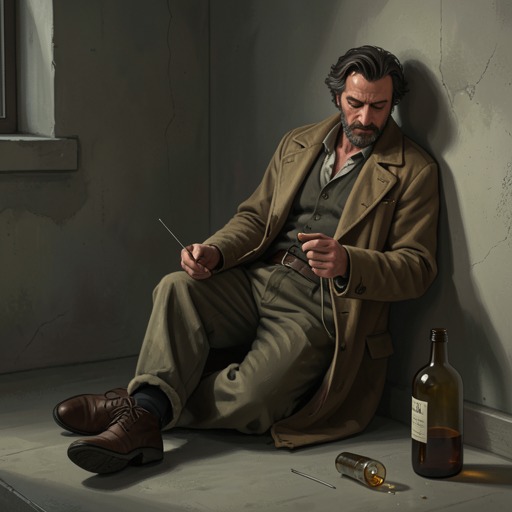
Before leaving Rue Notre-Dame-des-Champs for Rapallo, Pound gave Hemingway a final instruction: to keep a jar of opium and give it to Ralph Cheever Dunning only when Dunning needed it. The container was a large cold-cream jar; inside was a dark, sticky substance with the smell of very raw opium. Pound said he had bought it from an Indian chief near the avenue de l’Opéra and Boulevard des Italiens, and that it had cost a great deal. Hemingway suspected it might have come from the Hole in the Wall, a narrow red-fronted bar on the rue des Italiens associated in his account with deserters and drug peddlers during and after the First World War; the possible source is presented as his conjecture, not as established fact.
Dunning was a poet who smoked opium and forgot to eat. When he smoked too much, Hemingway recalled, he could only drink milk. His writing in terza riruce had endeared him to Pound, who also found fine qualities in his poetry. Dunning lived in the same courtyard as Pound’s studio, and Pound had called Hemingway in to help when Dunning was dying, a few weeks before Pound’s departure from Paris. The last errand thus links literary esteem to immediate care: Pound entrusted Hemingway with an expensive and unsettling object because he wanted it available to a vulnerable fellow poet when needed. Across the recollections, that act gives concrete form to the generosity that defines Pound’s place in Hemingway’s account.